
I met Zeenat through Suzy Walker (see links for her interview and gorgeous Heartleap community) and hope you are as inspired by her story about learning to receive care and love as I’ve been.
le grá (with love),
Ev3

CHAPTERS
(0:00) Burnout and learning to care for yourself
(2:23) Introduction and welcome to episode 111
(2:34) Meet Zeenat Ahmed-Peto
(3:40) Zeenat’s work and background in hypnotherapy
(5:18) Too Kind: A Survival Guide for Sensitive Souls
(6:13) Personal healing journey and chronic illness
(9:21) Feel: Ideal and essential self-care
(11:32) Sleep, stretching and walking as essentials
(14:07) Love: Learning to rest and receive care
(18:20) Heal: Community, connection and belonging
(21:17) Message to a Younger You
(23:18) Closing reflection and body scan
LINKS
Website:
https://zeenatahmedpeto.com/
Substack:
Heart Leap:
Book your free telephone consultation and access 100s of body-mind practices at https://solestosoul.ie/free-downloads
RELATED EPISODES
If you enjoyed this, check out:
Suzy Walker on meditation and more: Episode 14 of The Feel Better Every Day Podcast https://solestosoul.ie/podcast-feed/former-psychologies-editor-suzy-walker-talks-big-leaps-heart-leaps-meditation-and-more-as-she-shares-her-ideal-and-actual-self-and-self-care-practices/
Gill Fennings on taking things slow: Episode 15 of The Feel Better Every Day Podcast
Sarupa Shah on the art of doing nothing: Episode 6 of The Feel Better Every Day Podcast
Too Sensitive? Too Much? Says Who? Episode 78 of the Feel Better Every Day Podcast
HASHTAGS
#zeenatahmedpeto
#sensitivesouls
#sensorydifferences
#audhd
#solestosoulcarefortraumaandaudhd
FULL TRANSCRIPT
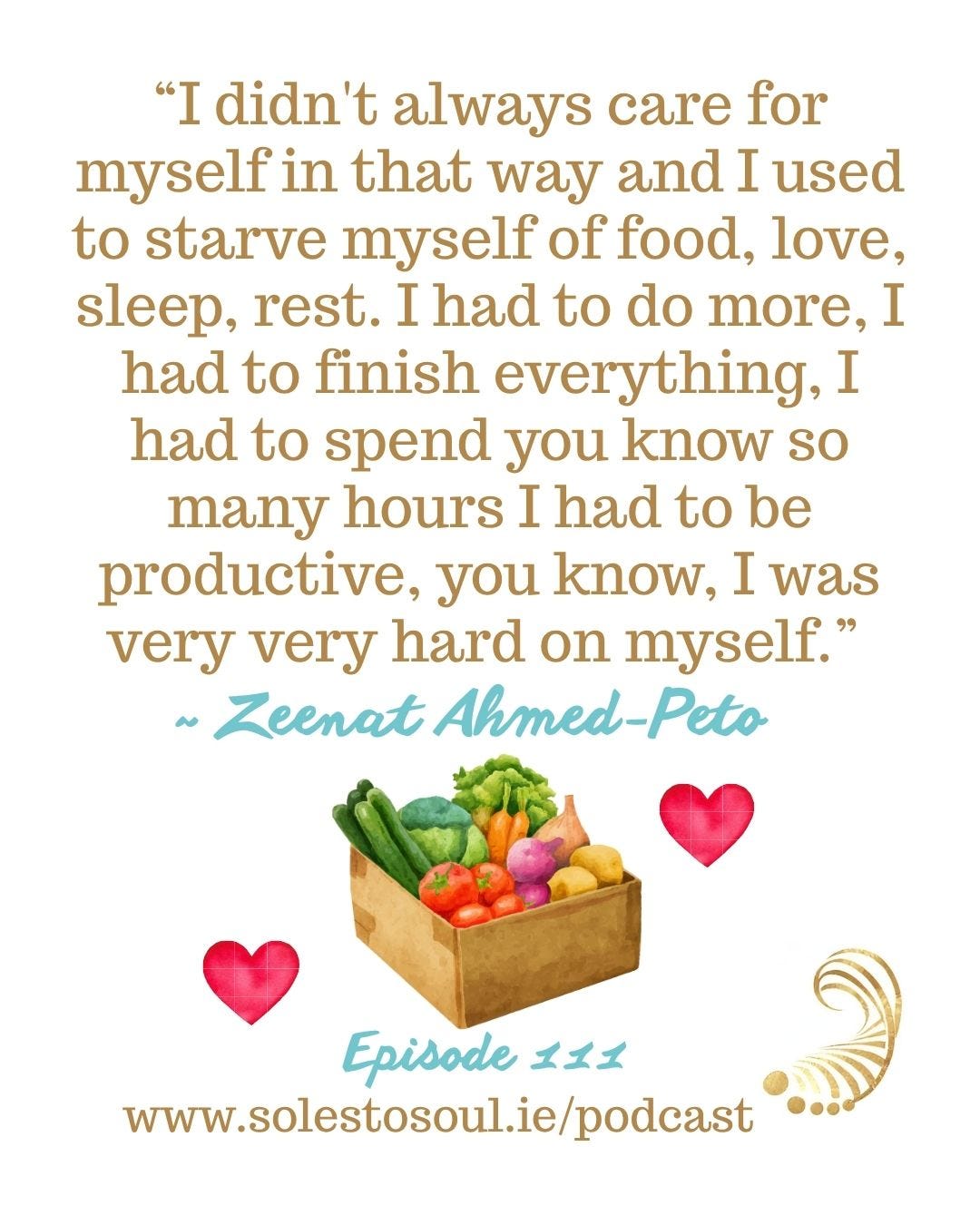
I didn’t always care for myself in that way and I used to starve myself of food, love, sleep, rest, I had to do more, I had to finish everything, I had to spend so many hours, I had to be productive, I was very, very hard on myself.
It’s only when I suffered quite severe burnout in my early 30s, it was coupled with the end of a long-term relationship, the health really declined, I was signed off from work and I remember, you know, the GP was like you really really really must rest. I’m not going to accept no for an answer, you need two weeks in bed, you know, that kind of thing.
Hi, you’re listening to Soles to Soul Care for Trauma and AuDHD. Learn to love and care for all your parts from the soles of your feet to your soul.
I’m your host Eve Menezes Cunningham, this is Mighty Meadbh, I’m a senior accredited supervisor, senior accredited counsellor, a therapeutic coach where I integrate all my offerings including psychosynthesis counselling, the trauma-informed therapies, the neurodivergent-affirming therapies, AuDHD coaching, yoga, breathwork, meditation, crystals, EFT, I’m a senior yoga teacher and EFT international advanced EFT practitioner and mentor and an NLP master practitioner.
I’m also the author of 365 Ways to Feel Better: Self-Care Ideas for Embodied Wellbeing, a columnist for Platinum magazine where I answer readers’ questions every month using the Feel. Love. Heal. framework that I use in these episodes.
The focus is on self-care, Self care and connecting with that highest, wisest, truest part of yourself and community care, collective care, the Feel. Love. Heal. framework.
There are new episodes every Tuesday so you can subscribe wherever you watch or listen and you can also access older episodes, free resources, more information at solestosoul.ie/podcast.
Thank you for listening, I hope you enjoy this episode.
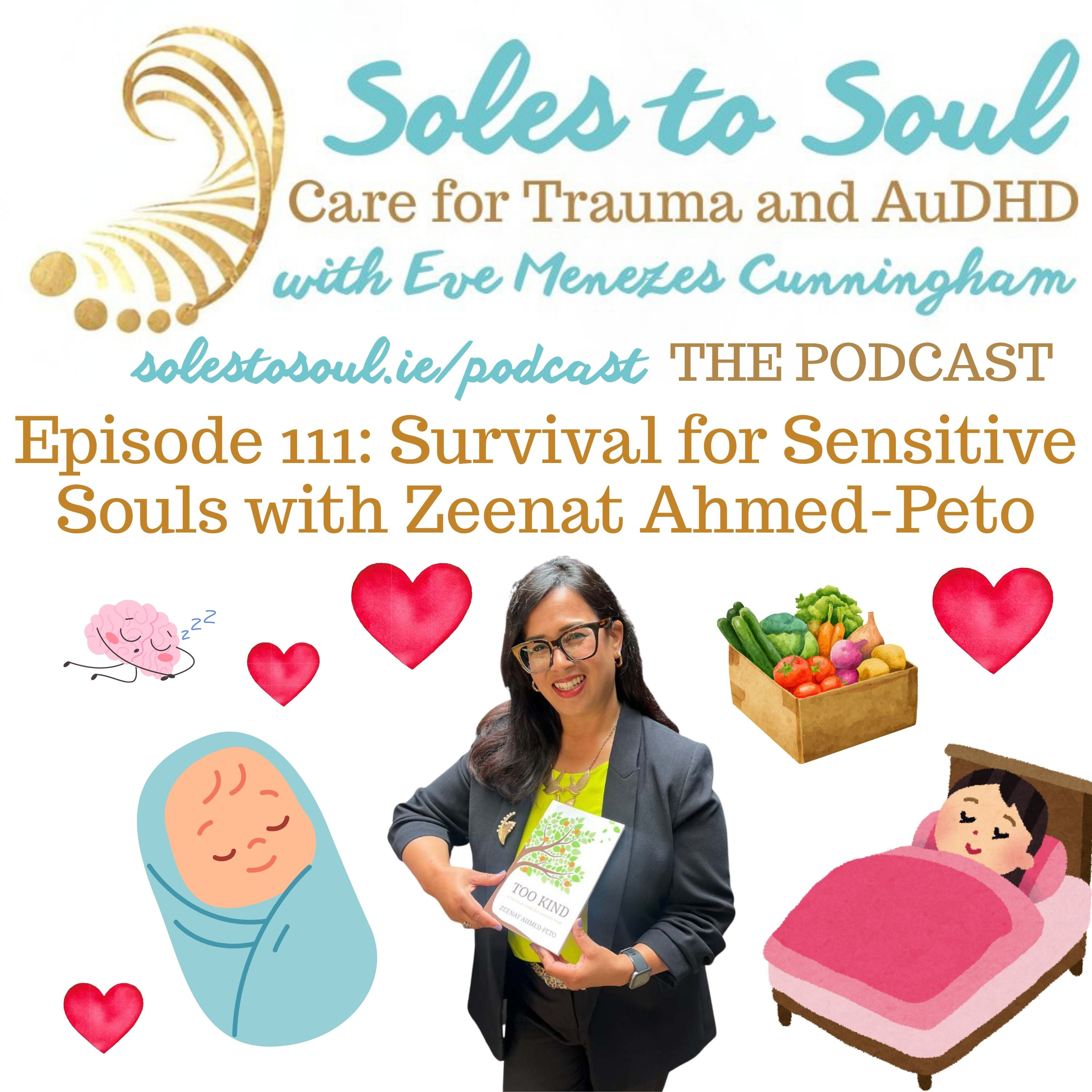
Welcome to episode 111 of the Soles to Soul Care for Trauma and AuDHD podcast. Today’s guest is Zeenat Ahmed-Peto and she is a delightful hypnotherapist, cognitive hypnotherapist and fellow author and just a gorgeous human being.
I met her through Suzy Walker’s gorgeous writers’ group Heart Leap, you can find out more on Substack and I just love her generous energy and was really excited to interview her for this, so I hope you enjoy the chat and look forward to hearing what you’re going to do differently as a result. So welcome Zeenat Ahmed-Peto, thank you so much for being here. Thank you for having me.
I met you through Suzy Walker’s Heart Leap club on Substack and we’re both members and I don’t make it to as many of the writing hours as I would like to but I’ve met you kind of through that online and it’s such a joy to have you here, author and cognitive hypnotherapist.
Do you want to say a bit about how you got into it and what you’re working on at the moment and the book?
Absolutely, thank you. You can find your website and links for the show notes.
Wonderful, thank you Eve. So I’m a cognitive hypnotherapist and that’s kind of an umbrella term really for lots and lots of different holistic practices within that. So there’s obviously hypnotherapy but I’m also an NLP master practitioner, I do EFT and EMDR and I’m currently training in sound healing as well and I like to work with crystals and the tarot and so on.
So I’ve got a real spiritual side to me but there’s also the sort of neuroscience back side with the positive psychology and so on. So you know like many therapists I wear lots of different hats. I came from a teaching background, I used to be a primary school teacher, I still love working with children so on occasion I work with families with children under sort of 12, 7 to 12 I would say but they’re always local because I work with them in person and I always work with the parents as well.
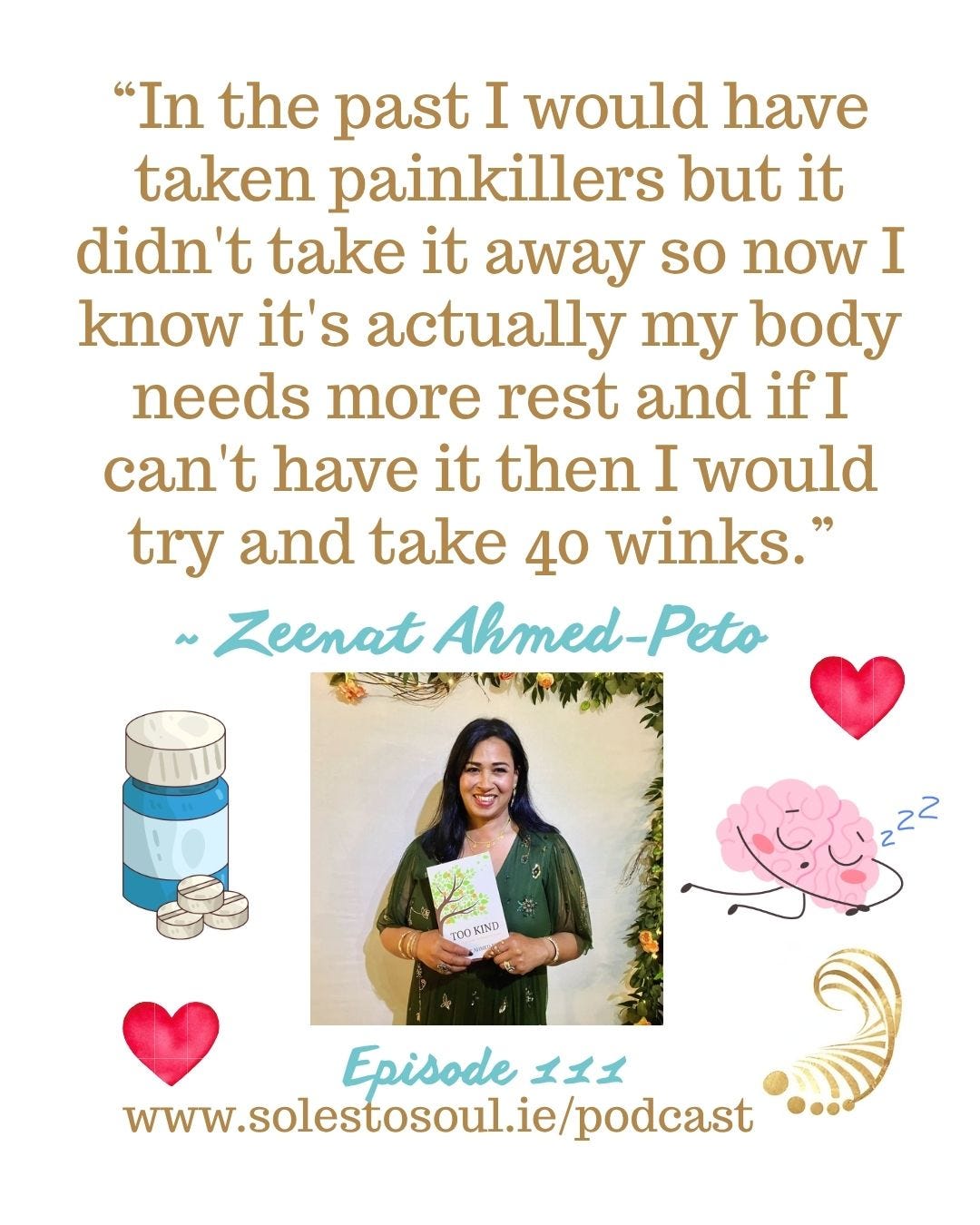
But my main area of expertise is working with sensitive people, tends to be sensitive female founders, they can be quite ambitious but they also tend to be real empaths. I also work with very empathic men, professional men, usually midlife who feel things in a very deep way and they seem to be attracted to the work that I do which is wonderful. My book that you mentioned Eve is called Too Kind: A Survival Guide for Sensitive Souls because I really like to help people with people pleasing when they’ve been doing that for too long and they just realise that they’re not taking care of themselves.
So my website that you mentioned is my name which is not easy to spell but it is zeenatahmedpeto.com and that’s where you can find it. I mean it will be in the show notes but just in case people are listening. If you’re listening and you’ve got a pen with you that’ll be handy, it’s phonetic my name so it’s zeenatahmedpeto.com is my website.
Thank you so much. And you were saying, so I got into all of this to save my own life and to heal like I had chronic pain condition endometriosis and it was training and all the things and I see I’m also an NLP Master Practitioner, EFT Advanced Practitioner, neuroscience backed with a lot of it, the holistic and crystal therapy. I realised recently I spent longer doing my crystal therapy training in terms of actual contact hours than I did my undergraduate English degree but that was the first thing I trained in because hospital prescribed painkillers weren’t working on what was then daily pain and it’s like there has to be more to this.
So you I know had your own journey, you were working on yourself, would you be happy to say a little bit about that? Of course, of course. So I unfortunately lost my father when I was 19 and at the time it was, you know, a huge shock. He was a GP and he just suddenly had a huge heart attack.
My mum was widowed very young and I overnight became her sort of companion and her looking after her, keeping her company and so on which was wonderful but it did take its toll on me and it was only a few years later I went to university, actually studied English and history and then became a teacher and was in my first job which was, you know, your first job standing up all day working really hard.
It was an inner city London school, it was a tough gig and physically I started to really struggle and they worked out eventually that I have an autoimmune type of arthritis or aortic arthritis. So I’ve had it now some 30 years and now, you know, I’ve finally kind of understood how my body works which has been life’s work but what I realised was if my white blood cells were, you know, attacking my body thinking they were foreign bodies there then maybe I could train my body to heal itself not just hurt itself.
And so came lots of interest in learning about, you know, how to heal the body, how to understand the emotions and the connection and the healing is, you know, we’re not two different parts, we’re many parts all together and they’re all connected and so on and so forth. So much of what you speak about Eve really resonates with what I’ve been through myself.
Thank you so much and I think that it’s one of those things like I’ve talked about self-care for decades but it’s always felt more like other people don’t seem to need it as much as I did.
It’s not a luxury, it helps me function and I think with chronic conditions with pain and I’m wondering about yourself so I’m really interested to hear what you’re going to say with the framework I talk about like what would be starting with the feel part of the Feel. Love. Heal. framework so the feel part is when you’ve got the bandwidth, you’ve got the energy and you can do something that’s going to help you feel better to help you regulate.
What would be your ideal self-care and what is an essential if perhaps you’re travelling or you’re really low on energy or in pain? Could you say a little about that? Absolutely, something you said there really resonated. I describe myself not to many people but to those very close to me like a very young baby that I need regular sleep, I need regular naps, I need regular feeding and I just need lots and lots and lots of cuddles and care and love and if I get all of those things I’m in a brilliant space so in terms of what is essential for me so should I say the essential part first?
No, go with ideal first.
Ideal, OK so the ideal part for me is waking up and being able to stretch and take my time, not be in any kind of rush, have a lovely cup of tea, have a lovely warm shower, ideally walk somewhere outside in nature, have a wonderful leisurely breakfast and then you know settle down to my day and ideally I love to move around in between my sessions of work and take lots of time to stretch and move because for me sitting still is not good for my condition so moving as much as possible is always involved so that’s my ideal and then did you want to know what my essential was like out of that?
Yes, so if you could only do one thing, I always feel evil asking that but like if you could only do one thing, you only have time or energy, what is your essential and also even though I’ve said if you could only do one thing, as many things as are essential.
I think the first most essential thing is for me sleep. Sleep for me cures everything so you know having enough sleep, a good night’s sleep is essential and you know for some people they can’t have sleep because it doesn’t come naturally to them but I’m you know touch wood I’m naturally good at sleeping, that’s something I’m good at, I don’t know how but I just am naturally but also sometimes if I wake up and I still feel a bit achy I know I need some more sleep so I can just snooze for an extra half an hour or an hour and that will take that pain away.
In the past I would have taken painkillers but it didn’t take it away so now I know it’s actually my body needs more rest and if I can’t have it then I would try and take 40 winks. I’ve parked up the car on occasion and just sat in a quiet road and had a sleep or just lay down on the sofa for half an hour and that honestly just takes it away so sleep is my number one and you were very generous and said I could have some more so I would say stretching, definitely stretching as much as possible is essential and the third one would be walking. Even if I was in one room you know I’ve been known to look at how many steps have I done and I’ve walked you know 5,000 steps just walking around the room listening to a podcast because I couldn’t get out that day because the weather was bad or whatever reason so I would say they’re my essentials.
OK that’s wonderful and I love that you’re good at sleep, it’s been one my specialisms for a long long time because I was an insomniac from early childhood until my 20s but it’s one of those things I’m going back to for myself because it is and I love what you said about going back to sleep like often people will be like they get up early in order to perform self-care practices whereas sleep is self-care and my partner regularly pulls over for a nap when he’s driving and I mean it’s safety as well isn’t it but I love there’s something so nourishing about that baby you it’s kind of how I developed my Polyvagal Purrs approach using the cats the rescue cats because generally people are so much more compassionate to a kitten or a puppy or a baby or a toddler and I adore that you’re doing that for yourself.
So that kind of leads us into the love, the acceptance that you’re perfect as you are, you’re part of nature, you’re part of the divine. What helps you connect with that when you are treating yourself as worthy, as a beloved baby of that care, that nap time, that feeding, that hugs, all the good things that babies need and adults need as well. What helps you get into that state where you allow that?
Absolutely, I didn’t always care for myself in that way and I used to starve myself of food, love, sleep, rest. I had to do more, I had to finish everything, I had to spend you know so many hours I had to be productive, you know, I was very very hard on myself.
It’s only when I suffered quite severe burnout in my early 30s, it was coupled with the end of a long-term relationship. The health really declined, I was signed off from work and I remember the GP was like you really really really must, I’m not going to accept no for an answer, you need two weeks in bed, you know, that kind of thing.
And that’s when my life started to change because I realised that lying in bed and being cared for and everybody kind of coming around you know family coming and sort of understanding quite how bad it was. I was so good at hiding it and I sort of allowed myself to let go and to accept and the first thing that happened is I got a mouthful of ulcers from the amount of stress I was under.
Slowly but surely that was healing and everything was healing and I realised that this feeling of being comfortable, comfort under a blanket, under you know a sort of heavy duvet, just being warm and cosy and not having to get up and not having to produce things and make things and tidy things and clean things and do work, it was okay and I think every time I have that feeling of oh I’m really a bit tired today, I’m a bit achy, I think I need a bit more rest and I sort of slide into bed and I get that same feeling that I had which was the realisation that this is what I need.
It’s like it’s womb, you know, it’s you’re so kind of worthy like you say but sort of connected to yourself and the most simple thing you know just being wrapped up and warm is really nourishing.
You say it’s simple and it is but it’s also like it’s part of the decolonisation work we all have to do on ourselves. We used to know that we were connected to our bodies, to nature, to that and it’s over centuries of like that separation and that lack of empathy and othering of even the being productive or the it’s like no even though it’s that kind of counterintuitive because rest and sleep makes us more productive but we’re not doing it for that, we’re doing it because we deserve rest and sleep. It’s like if I rest I’ll then be able to whatever and I think especially working with trauma, working with ADHD so much it’s so, I’m 50 now and it’s still such a huge triumph for me when it’s like yay nap or like the yoga nidras even are more productive than a simple nap. I love what you’re saying. I’m getting a bit enthusiastic. What about the heal part, the collective care, the co-regulation. I love what you were saying about being able to accept visitors, being able to accept your family. A lot of people can’t even when their bodies are trying to force them. What communities do you co-regulate with both in terms of receiving that care, that collective care and also giving?
So for me the giving part’s always easier. I’m always thinking up the next, you know, I’m running a retreat on Friday, there’s always the next thing that, oh this would be lovely, like beautiful place to relax and it’s like oh maybe I need that you know so I’m very fortunate, I have a lovely family, so I have my you know my own little unit of husband and child and I also have my birth family and their you know partners, so we’ve got a little unit there and that’s lovely because when I’m with them I can always completely relax which is wonderful.
I have a very small close-knit group of friends who go back many many years and you know have like little satellite friends who when I’m with them I feel like I’m at home so I’ve got these kind of very close friendships and then I’ve got lots of networks of groups of people like the Heart Leap, which you know I want to be more involved with and want to spend more time there but they’re really lovely groups.
Every time I’m there I feel a sense of community connection. I’m good at creating that for other people and I run a business networking group as well and I have sought those places out and I’ve got lots of connections locally where they run sound baths or day retreats or just an evening gathering like a moon gathering or something like that so there’s lots of circles at any time I could find. There’s probably 15 on my phone that pinged up during this conversation that I could go and join in with so I’m very very fortunate in that way but I’ve had to sort of seek those groups out. I’ve had to find those people because I would say even six or seven years ago I didn’t have those communities.
Took going out of my comfort zone going and meeting people I’d never met before going and speaking in groups I’d never met before and just showing up and seeing what happened and I didn’t know that those connections would form but they have over time and that trust and I’ve just joined a book club which is so exciting. We’re meeting next week for the first time so that’s going to be another lovely community where I can just throw myself into a novel and chit chat about it for a few hours. I love it, absolutely love it, so thank you very much.
If you were to go back I’m guessing but it might be different but if you were to go back with some love, some compassion, some wisdom for a younger version of yourself, what age would it be and what would you be saying and doing?
So she’s presenting as a sort of five, six year old. She’s in the playground and there are some bigger girls who are being a bit mean. They’re just kind of teasing and calling names and that kind of thing and I think what I’m really sending her is a feeling that she can share this, that it’s OK for her to go and tell somebody, that she doesn’t have to hold it by herself and it’s OK for her to tell them that that’s not okay and I think just knowing that it’s all right to say what’s happening. I think that would make a huge difference to her.
I was holding my breath when you were saying that, it’s so lovely, it’s so needed. It’s so heartbreaking to think how much we hold in as small children protecting the adults around us rather than letting them protect us but thank you, thank you, thank you, absolute pleasure talking to you. Do you want to say again where people can find you online?
Absolutely. So you can find me on my website which is www.zeenatahmedpeto.com and I also have a Substack called The Authentic Connection at Substack.
Wonderful, thank you so much. Before you get in with something else I’m going to encourage you to pause for a moment and scan your whole being from the soles of your feet to your soul and the crown of your head and notice what you’re aware of. Notice any physical sensations, pleasant, unpleasant, warmth, tingly, whatever it may be. Just being curious about what you’re feeling as you’ve listened to this episode, making a note, asking what those sensations might be trying to help you with, what you might benefit from doing for your body right now, being aware of your thoughts, noticing any feelings that feel more prominent as a result of listening to today and any intuitions, any insights, anything that you can actually schedule into ground and improve your life in some way.
So let me know how you get on. Make a note, doodle, journal, whatever feels good for you and thank you for listening. This episode like all of them was produced by me your host Eve Menezes Cunningham and I look forward to sharing more next week.
You can find out more and access old and free resources and more information at solestosoulcare.ie/podcast. See you next week.